Revenue Quality: Why Buyers Don’t Pay for What They Can’t Count On
Jun 12, 2026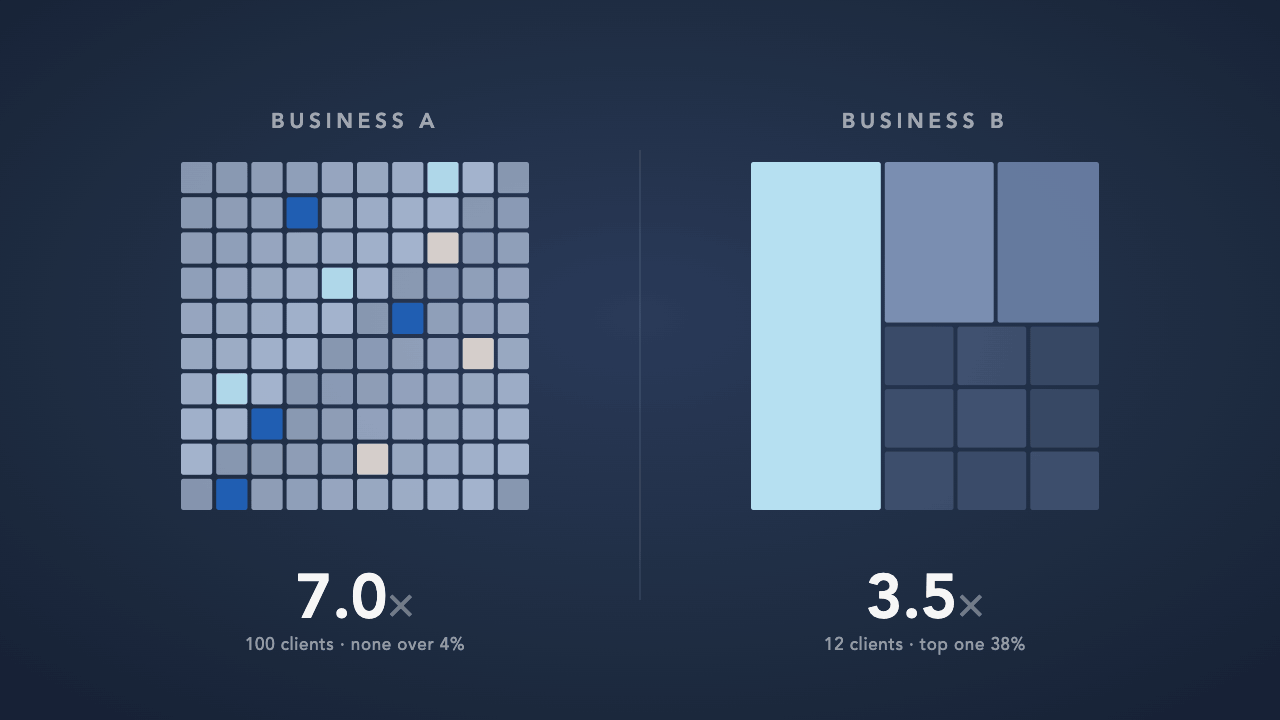
Two businesses, same industry, same size.
Business A. $10M in revenue. 100 clients. No client more than 4% of the total. Average client tenure: 6 years. 90% of revenue is on annual contracts that auto-renew. Net revenue retention: 108%.
Business B. $10M in revenue. 12 clients. Top client is 38%. Top three are 67%. No contracts, just handshake relationships. Two clients have been there forever. The rest churn every couple of years.
Same revenue. Same EBITDA, let’s say. Same industry.
Business A trades for 7x. Business B trades for 3.5x. If B trades at all.
That’s not arbitrary. That’s not buyers being unfair. That’s the math of risk.
What buyers are actually buying
When I write a check for a business, I’m not buying last year’s revenue. I’m buying next year’s revenue. And the year after that. And the year after that.
Last year’s number is just the starting point. The real question is how confidently I can underwrite the next five years.
Business A is easy to underwrite. The customers are diversified. The contracts are recurring. Retention is strong. No single relationship can blow up the model. The risk of a 20% revenue drop next year is low. I can borrow against it. I can model it. I can sleep at night.
Business B is a different animal. One bad phone call from the 38% client and I’ve lost a third of the business. There are no contracts holding anything in place. The relationships might be strong, but they belong to the seller. And the seller is leaving.
The buyer for Business B exists. But that buyer is paying half the multiple, asking for a big seller note, and structuring an earnout to mitigate the concentration risk. Probably all three.
What makes revenue “high quality”
When I look at a business, I’m scoring revenue on five things.
- Recurring vs. one-time. Subscription, retainer, contracted. That’s gold. Project work that doesn’t repeat is the opposite. A $10M services firm that has to re-win every dollar each January is not the same as a $10M SaaS business with 95% gross retention.
- Concentration. No client should be more than 10 to 15% of revenue. Top 5 should be under 40%. The looser those numbers get, the more the multiple compresses.
- Contract length and terms. Annual contracts beat month-to-month. Multi-year contracts beat annual. Auto-renew language is worth real money. So is termination-for-convenience language, going the other way.
- Customer tenure and retention. A 10-year client who renews every year tells a story. A roster of 18-month relationships tells a different one.
- Pricing power. Have you raised prices in the last three years? Did you lose anyone? If you can raise prices and keep the customers, that’s not just margin. That’s a moat.
Where this lands
Most owners read this and immediately know which business they’re closer to. That’s the easy part.
The hard part is what comes next. Improving revenue quality isn’t a project. It’s a multi-year operating discipline. Every quarter you do this work, your business is becoming more valuable, whether you sell or not.
When clients hire me to work on this, or even when founders go through my online course, this is where we spend a meaningful amount of time. Because the gap between Business A and Business B isn’t talent or luck. It’s a series of operating choices, made consistently, over a long enough horizon. Most owners don’t see those choices until a buyer points them out. By then, it’s late.
If you’re reading this and you can’t honestly tell which business you’re closer to, that’s the answer. You’re closer to B.
Want to work one-on-one with me to get your business exit-ready? Apply now to schedule a free call where we go over your business in detail. Apply for a FREE Call Now >>
If you didn’t know, now you know.
* Every deal I look at is under NDA. The stories I discuss are real. Some identifying details — company name, specific geography, exact numbers — may have been changed to protect the seller. The lessons haven’t.